Beginner Dress Sewing: From Measurements to Finished Garment
Sewing your first dress is a milestone that transforms your relationship with clothing forever. Once you have made a garment that fits your body, you will never look at a store rack the same way again. If the idea of beginner dress sewing feels intimidating, let us reframe it: if you can sew a straight line and follow a logical sequence of steps, you can sew a dress. The key is starting with a good pattern, accurate measurements, and a fabric that cooperates rather than fights you.
A made-to-measure pattern takes the hardest part of dress sewing -- fitting -- and automates it. Instead of wrestling with a commercial pattern that might need bust adjustments, waist darts moved, or the hem shortened by three inches, you enter your measurements and receive a pattern drafted for your body. This means your first beginner dress sewing project can focus on learning construction skills rather than fitting skills, which makes the experience vastly more enjoyable and the result far more wearable.
This guide covers the complete journey from measuring tape to finished garment. We will choose a beginner-friendly dress style, select the right fabric, walk through every construction step, and troubleshoot common issues. By the end, you will have a dress you are proud to wear and the confidence to tackle more ambitious projects.
Choosing a Beginner-Friendly Dress Style
Not all dresses are created equal in terms of sewing difficulty. For your first project, look for these characteristics: few pattern pieces, no complicated closures, a forgiving fit, and a construction sequence that builds on basic skills. Two styles meet all of these criteria beautifully.
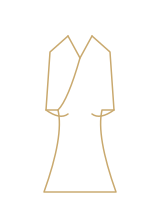
The wrap dress is an outstanding first dress. It has no zipper -- the wrap closure eliminates the need for any hardware. The fit is forgiving because the wrap adjusts to your body as you tie it. Construction involves shoulder seams, side seams, a waist tie, and hemming. If you can handle those operations, you can make a wrap dress.
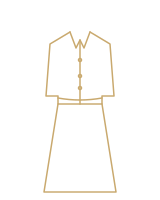
The shirt dress is another excellent choice. It buttons up the front, which means the bodice is relatively flat and easy to assemble. The shirtdress construction teaches you collar and cuff techniques that carry forward into dozens of other garments. It has more pieces than a wrap dress, but each step is straightforward.
Choose whichever style appeals to you more. Both are forgiving, both produce a wearable garment, and both are well-supported by the made-to-measure patterns at People's Patterns.
Gathering Your Supplies
Before taking measurements or cutting fabric, make sure you have these essentials on hand:
- Sewing machine -- Any functioning home machine will work. You do not need anything fancy.
- Iron and ironing board -- Pressing is half of sewing. A good iron makes everything look more professional.
- Fabric scissors or rotary cutter -- Sharp cuts make clean seams.
- Pins or sewing clips -- For holding fabric in place before stitching.
- Measuring tape -- A soft, flexible tape for body measurements.
- Tailor's chalk or washable marker -- For transferring pattern markings to fabric.
- Thread -- All-purpose polyester thread in a color that matches your fabric.
- Seam ripper -- Every sewist needs one. Mistakes happen, and a seam ripper lets you fix them cleanly.
You probably already own most of these items or can acquire them for a modest investment. Do not let the supply list overwhelm you -- you will use every one of these tools on every garment you make going forward.
Taking Your Measurements
Accurate measurements are the foundation of beginner dress sewing with a made-to-measure pattern. Wear lightweight, close-fitting clothing (or just underwear) and stand naturally. Have someone else take the measurements if possible -- it is difficult to measure yourself accurately, especially for shoulder width and back measurements.
- Bust -- Around the fullest part of the chest, tape parallel to the floor.
- Waist -- At the natural waistline, the smallest part of the torso. Tie a ribbon or elastic around your waist and let it settle to find this point.
- Hips -- At the fullest part of the seat, tape parallel to the floor.
- Shoulder width -- From the bony tip of one shoulder, across the back of the neck, to the other tip.
- Bodice length -- From the shoulder point, over the bust, to the natural waistline.
- Skirt length -- From the natural waistline to the desired hem (knee, below-knee, midi, etc.).
Write everything down and double-check each measurement before entering it into the pattern generator. A half-inch error at the bust translates to a full inch of circumference error in the pattern -- small inaccuracies add up.
Choosing Fabric for Your First Dress
Fabric choice can make or break a beginner's first sewing experience. For a woven dress (wrap dress or shirt dress), choose a medium-weight cotton like cotton poplin, cotton lawn, or chambray. These fabrics are stable (they do not stretch or slip), they press beautifully, and they come in a wide range of colors and prints.
Avoid these fabrics for your first dress: anything very slippery (silk, satin, rayon), anything very stretchy (jersey, ponte), anything very stiff (canvas, heavy denim), and anything very sheer (chiffon, voile). These fabrics require handling techniques that add unnecessary complexity to a first project.
You will need two and a half to three yards of 45-inch-wide fabric, or about two yards of 60-inch-wide fabric. Buy an extra quarter yard as insurance. Pre-wash the fabric the way you will wash the finished dress -- machine wash and tumble dry for cotton -- then press it flat before cutting.
Printing, Assembling, and Cutting the Pattern
Generate your made-to-measure pattern, download the PDF, and print it at 100 percent scale on regular letter or A4 paper. Check the printed test square with a ruler to verify it is the correct size. Trim the borders from each page and tape the pages together following the assembly diagram.
Lay your pressed, pre-washed fabric on a large, flat surface. Place the pattern pieces according to the layout guide, aligning grainline arrows with the fabric grain (parallel to the selvage). Pin or weight the pattern in place, then cut carefully along the cutting lines with sharp scissors or a rotary cutter. Transfer all darts, notches, and other markings to the fabric.
Take your time with this step. Accurate cutting and clear markings make the sewing process much smoother. Label each piece with a scrap of masking tape if you are worried about keeping track of what goes where.
Sewing Your Dress Step by Step
The exact construction order depends on your chosen dress style, but the general sequence for a beginner dress sewing project follows this flow:
- Sew darts -- If your pattern includes bust darts or waist darts, sew these first on the individual bodice pieces. Press darts downward on the front and toward the center on the back.
- Sew shoulder seams -- Join the front bodice to the back bodice at the shoulders. Press seams open or toward the back.
- Finish the neckline -- Apply a facing, binding, or collar as your pattern indicates.
- Set sleeves (if applicable) -- For a shirt dress, set the sleeves into the armholes and sew the cuffs.
- Sew side seams -- Join the front to the back from underarm to waist (or underarm to hem if the bodice and skirt are one piece).
- Attach skirt to bodice -- If they are separate pieces, join at the waistline seam.
- Hem -- Fold and stitch the bottom edge.
- Add closures -- Buttons, ties, snaps, or hooks as needed.
Press every seam as you complete it. This is not optional -- pressing is what makes the difference between a garment that looks homemade and one that looks professional. Press seams open for the flattest finish, or press them to one side if your pattern specifies.
Troubleshooting Common Beginner Issues
Your first dress will not be flawless, and that is perfectly fine. Here are the most common issues and how to handle them:
Waist is too loose or too tight: Double-check your waist measurement. If it is correct, the issue may be that you measured your natural waist but the dress waistline sits higher or lower. Re-measure at the point where the dress waist actually falls.
Shoulders do not sit right: Check your shoulder width measurement. Also verify that the shoulder seam is landing at the bony tip of your shoulder, not sliding forward or back.
Hem is uneven: This usually happens when the fabric was not on grain during cutting, or the fabric was cut on a surface that was not perfectly flat. For the next version, take extra care with grainline alignment.
Puckered seams: Tension may be too tight, or the needle may be dull. Try reducing tension slightly and installing a fresh needle.
Each issue you encounter and solve makes you a better sewist. Keep notes on what you learned from your first dress so you can apply those lessons to the second one.
Your Finished Dress and Next Steps
Once hemmed and pressed, try your dress on and take a moment to appreciate what you have accomplished. You took a flat piece of fabric and a set of measurements and turned them into a three-dimensional garment that fits your body. That is beginner dress sewing at its most rewarding.
If the fit is good, make the same pattern again in a different fabric to reinforce what you learned. If the fit needs tweaking, adjust your measurements and generate a new pattern -- the beauty of made-to-measure is that corrections are small and logical.
When you are ready for more, explore other dress styles like the wrap dress or the shirt dress. Or branch out into separates -- skirts, trousers, and tops -- using the full pattern collection. Every garment you make builds on the skills you learned here, and every one will fit because it starts with your measurements.
Frequently Asked Questions
What is the easiest dress to sew as a complete beginner?
A wrap dress or a simple shirt dress are the most beginner-friendly options. Both have straightforward construction, forgiving fits, and no complicated closures like invisible zippers or buttonhole rows. A made-to-measure pattern simplifies the fitting process, which is usually the biggest challenge for beginners.
How many measurements do I need to sew a dress?
Most dress patterns need 5 to 7 measurements: bust, waist, hips, shoulder width, bodice length (shoulder to waist), and desired skirt length. Some patterns also ask for upper arm circumference for sleeve fitting.
How long does it take a beginner to sew a dress?
Plan for 6 to 10 hours spread over two to three sewing sessions for your first dress. This includes cutting, marking, sewing, pressing, and hemming. The time decreases significantly with each subsequent dress you make.
What if my dress does not fit perfectly on the first try?
That is completely normal. Even experienced sewists make test garments. Check your measurements against what you entered in the pattern generator. Common first-attempt issues include a too-long bodice or slightly off waist placement, both of which are easy to correct for the next version.
Ready for your perfect fit? Start with a free pattern →
Patterns that use this
Related articles
Straight-Leg Jeans for Men: The Custom Fit Difference →Gym Shorts That Don't Ride Up -- Custom Drafting Magic →Try these patterns
Generate a custom-fit pattern in minutes. First pattern free.