Full Bust Adjustment? Skip It -- Here's How Custom Patterns Solve It Automatically
The Full Bust Adjustment Problem
If you have spent any time sewing garments with standard patterns, you have probably heard of the full bust adjustment. The FBA is one of the most commonly recommended alterations in sewing, and for good reason: standard patterns are drafted for a B or C cup, and anyone with a larger bust needs to add room to the bodice for the garment to fit properly. The full bust adjustment involves slashing the pattern, spreading it at the bust point, adding a dart or increasing an existing one, and then truing up all the seam lines so everything still connects. It is fiddly, time-consuming, and intimidating for beginners.
But here is the thing: the full bust adjustment only exists because standard patterns do not account for your actual bust measurement. They assume a fixed relationship between your bust, waist, and high bust, and when your body does not match that assumption, you have to manually add the missing room. It is a workaround for a limitation in the pattern, not a fundamental requirement of garment construction.
Custom-drafted patterns eliminate the need for a full bust adjustment entirely. When a pattern is generated from your actual measurements, including your full bust and high bust, the bodice is drafted with the correct amount of room from the start. No slashing. No spreading. No truing up seam lines. The dart is placed correctly, the side seams are the right length, and the bodice fits your bust without any manual alteration.
Why Standard Patterns Need an FBA
Standard sewing patterns use a size chart that assigns one bust measurement per size. A size 12 might have a 38-inch bust. But the pattern does not know whether that 38 inches includes a B cup on a wide ribcage or a DD cup on a narrow ribcage. Those two bodies have the same circumference but very different shapes, and they need very different bodice patterns.
The standard pattern is drafted for the assumed proportions, usually a B or C cup. If your cup size is larger, the bodice will be too tight across the bust, the dart will sit too low, and the side seam will pull forward. The full bust adjustment corrects all of these problems, but it requires you to understand the relationship between your bust measurement, your high bust measurement, and the pattern's ease allowances. That is a lot of knowledge for someone who just wants a shirt that fits.
How Custom Patterns Draft the Bust Correctly From the Start
When you enter your measurements into People's Patterns, the system asks for both your full bust measurement and your high bust measurement (the circumference above the bust, under the arms). The difference between these two numbers tells the engine how much room the bust needs relative to the rest of the bodice. This is essentially the same information that a full bust adjustment adds manually, but the engine uses it during the initial draft rather than after.
The pattern engine calculates the dart size and placement based on your specific bust point position. It adjusts the side seam length so the front and back panels still match at the seams. It distributes the ease correctly so the garment hangs naturally rather than pulling toward the bust. All of this happens automatically, in the same step that generates the rest of the pattern.
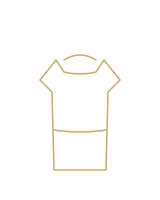
The result is a fitted tee or shell blouse that fits your bust without any post-draft alteration. The bodice has exactly the room it needs, the dart points in the right direction, and the seam lines are already trued up because they were drafted correctly from the start.
Dart Placement: Why It Matters and How Custom Patterns Get It Right
The bust dart is what gives a flat piece of fabric the three-dimensional shape it needs to fit over a curved bust. In a well-fitting garment, the dart points toward the apex (the fullest point) of the bust. If the dart is too high, the bodice pulls at the bust and feels tight. If the dart is too low, there is excess fabric above the bust and the neckline gaps.
Standard patterns place the dart based on the fit model's proportions. If your bust apex sits higher or lower than the fit model's, the dart will be in the wrong position. This is another thing you have to fix manually with a standard pattern: you measure the distance from your shoulder to your bust point, compare it to the pattern, and move the dart up or down accordingly.
Custom patterns calculate the dart position from your measurements. The engine knows the distance from your shoulder to your bust point and from your center front to your bust point. It places the dart at the correct position for your body, so the shaping is where it needs to be without any adjustment on your part.
What About Small Bust Adjustments?
The full bust adjustment gets most of the attention, but small bust adjustments are just as common and just as tedious. If your bust is smaller than the standard pattern assumes, the bodice will have too much room at the bust, creating excess fabric that wrinkles and gaps. The small bust adjustment involves the same slash-and-overlap technique as the FBA, but in reverse: you remove fabric instead of adding it.
Custom patterns handle small busts the same way they handle full busts: by drafting the correct amount of room from the start. If your bust measurement is 34 inches and your high bust is 33 inches, the engine drafts a bodice with a small dart and minimal shaping. If your bust measurement is 42 inches and your high bust is 36 inches, the engine drafts a bodice with a larger dart and more shaping. Either way, the pattern is correct from the start. No alteration needed.
Beyond the Bust: How Custom Patterns Handle the Whole Bodice
The full bust adjustment is the most well-known bodice alteration, but it is not the only one. Standard patterns can also need adjustments for broad or narrow shoulders, a forward shoulder angle, a rounded upper back, or a long or short torso. Each of these is a separate alteration that you have to identify, measure, and execute manually.
A custom pattern addresses all of these in the initial draft. Your shoulder width measurement ensures the shoulder seam sits at the correct point. Your back width and front width measurements balance the bodice from front to back. Your shoulder-to-waist measurement sets the bodice length. The result is a bodice that fits your whole upper body, not just the bust.
This is especially valuable for garments like a wrap dress, where the bodice needs to fit well while also accommodating the wrap closure. Getting the bust, shoulder, and waist all correct in a single draft means the wrap falls naturally and the neckline sits where it should.
Time Saved: FBA Versus Custom Drafting
A full bust adjustment on a standard pattern takes most people 30 to 60 minutes once they know how to do it. For beginners, it can take much longer because the concept is abstract until you have done it a few times. And the FBA is just one of potentially several alterations you might need on a single garment.
Generating a custom pattern from your measurements takes about two minutes. You enter your numbers, choose your garment and options, and the pattern engine does the rest. There are no alterations to make after the fact because the pattern is drafted correctly from the start.
That time savings adds up. If you sew regularly and need an FBA on every bodice pattern you use, switching to custom-drafted patterns gives you back hours per project that you can spend on the parts of sewing you actually enjoy: choosing fabric, sewing, and wearing your finished garments.
Getting Started: Your First Custom Bodice Pattern
If you have been doing full bust adjustments on every pattern and you are tired of the extra work, try a custom-drafted pattern and see the difference for yourself. Start with something simple like a fitted tee or a shell blouse. These garments have straightforward construction, so you can focus on evaluating the fit rather than wrestling with complicated sewing techniques.
Take your measurements carefully, including the full bust and high bust. Generate your pattern and sew a quick muslin. When you try it on and the bodice fits your bust without any slashing, spreading, or dart-moving, you will understand why custom drafting makes the full bust adjustment obsolete.
Frequently Asked Questions
What is a full bust adjustment in sewing?
A full bust adjustment, or FBA, is a pattern alteration that adds extra room to the bust area of a bodice pattern. It involves slashing the pattern, spreading it to add width and length at the bust point, and then truing up the seam lines. It is one of the most common alterations needed with standard-sized patterns.
Do I still need an FBA with a custom-drafted pattern?
No. A custom-drafted pattern uses your actual bust measurement as an input, so the bodice is drafted with the correct amount of room from the start. The dart placement and bodice shaping are calculated for your specific bust size and position.
What about a small bust adjustment?
The same principle applies. If your bust measurement is smaller than the standard size chart assumes, a custom pattern simply drafts the bodice with less room at the bust. No alteration needed.
Will the dart placement be correct for my body?
Yes. Custom patterns calculate dart placement based on your bust point position relative to your shoulder and waist. This means the dart points toward the apex of your bust rather than sitting too high or too low, which is a common problem with standard patterns.
Ready for your perfect fit? Start with a free pattern →
Patterns that use this
Related articles
Athletic Builds: Why Off-the-Rack Never Fits and Custom Patterns Do →Short or Tall? How Made-to-Measure Automatically Adjusts Lengths →Try these patterns
Generate a custom-fit pattern in minutes. First pattern free.