Plus Size Sewing: Why Standard Patterns Fail and Custom Ones Win
The Plus Size Pattern Problem
Plus size sewing should be empowering. It should be a way to make clothes that fit your body beautifully, in fabrics and styles that you love. But for many plus-size sewists, the experience is the opposite: frustrating, discouraging, and marked by patterns that never quite fit despite following all the instructions and taking careful measurements.
The problem is not you. The problem is how standard sewing patterns are created. Most pattern companies design for a fit model in the middle of their size range, usually around a size 8 to 12, and then grade the pattern up and down to create the full size range. Grading outward to larger sizes assumes that every body dimension increases proportionally as the overall size increases. But bodies do not work that way, especially in the plus size range where individual variation in body shape is enormous.
Custom-drafted patterns solve this problem by starting with your measurements rather than a size chart. There is no grading, no assumed proportions, and no compromise. The pattern is drafted for your body, whatever size that body happens to be. And that makes all the difference.
Why Grading Fails for Plus Sizes
Grading is the process of scaling a pattern up or down from the base size. The grading rules specify how much to add at each point of the pattern for each size increment. For example, a grading rule might add 0.5 inches at the side seam for each size, distributed between front and back.
These rules work reasonably well for sizes close to the base size. A size 10 graded from a size 8 fit model is only one size away, so the proportional assumptions hold up. But a size 24 graded from a size 8 fit model is eight sizes away. The accumulated assumptions become significant:
- Ease distribution changes. A larger body needs more ease in some areas and less in others compared to what proportional grading provides. The bust may need more room relative to the shoulders. The hips may need a different front-to-back distribution.
- Body proportions diverge. The ratio of bust to waist to hip changes across the size range. A size 24 body is not a scaled-up size 8 body. The proportional relationships are different.
- Length proportions shift. Torso length, rise, and inseam do not increase at the same rate as circumference. Grading often makes plus-size garments too long in the torso or too short in the rise.
- Armhole and neckline shapes distort. When the overall pattern is scaled up, the armhole and neckline grow proportionally, but these areas need different scaling than the body circumference. The result is armholes that are too large and necklines that gap.
The Shape Problem: Not All Plus-Size Bodies Are the Same
One of the biggest failings of standard plus-size patterns is the assumption that all plus-size bodies have the same shape. But the plus-size range includes an incredibly diverse set of body shapes. Some people carry weight primarily in the bust and stomach. Others carry it in the hips and thighs. Some have broad shoulders with a proportionally smaller lower body. Some have a long torso and shorter legs. The variety is enormous.
Standard patterns cannot account for this variety because they use a single set of grading rules for the entire size range. They might accommodate one common plus-size body shape reasonably well, but anyone whose proportions differ from that assumed shape will need significant alterations.
Custom patterns do not make assumptions about body shape. They use your actual measurements for each dimension independently. If your bust is 48 inches and your waist is 38 inches, the pattern is drafted for that 10-inch difference. If your bust is 48 inches and your waist is 44 inches, the pattern is drafted for that 4-inch difference. The engine handles whatever proportions your body has, without judging them or trying to fit them into a predefined category.
The Ease Problem: Why Plus-Size Garments Often Feel Wrong
Ease is the extra room in a garment beyond your body measurements. It allows you to move, breathe, and be comfortable. Different garment styles have different amounts of ease: a fitted top has less ease than a relaxed one, and a coat has more ease than either.
Standard patterns determine ease based on the garment style, and the same ease is applied to all sizes through grading. But ease needs change at different sizes. A larger body may need proportionally more ease across the back for comfort, or less ease at the hip because the fabric drapes differently over a curvier shape. Uniform ease application results in garments that feel too tight in some areas and too loose in others, even when the overall circumference is correct.
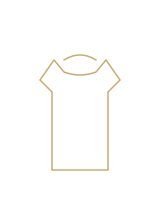
People's Patterns calculates ease based on your specific measurements and the garment style. The engine adjusts ease distribution for your proportions, ensuring that the garment feels comfortable and looks balanced on your body. Whether you are making a tee for casual wear, straight jeans for everyday, or a wrap dress for a special occasion, the ease is tailored to you.
Representation and Design Variety
Another frustration in plus size sewing is the limited design variety available. Many pattern companies offer their full design range only up to a certain size, and the styles available in the extended size range tend to be simpler and more conservative. If you want a trendy silhouette, a complex design detail, or a body-conscious fit, your options shrink as your size increases.
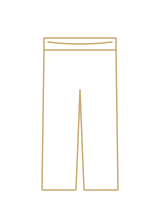
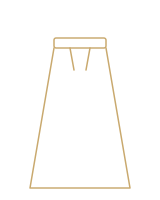
Custom-drafted patterns do not have this limitation because the design is separate from the sizing. Every garment in the People's Patterns catalog is available for every measurement set. Want pleated trousers? Available in your measurements. Want a crop jacket? Available in your measurements. Want a slip skirt? Available in your measurements. There is no extended size range because there is no size range at all. There are just your measurements.
The Emotional Side of Plus-Size Sewing
Let us be honest about something: poorly fitting clothes do not just look bad. They make you feel bad. When you spend hours sewing a garment and it does not fit, it is hard not to take it personally. The pattern says it is your size, but it does not fit your body. It is easy to blame yourself rather than the pattern, and that emotional toll builds up over time.
Custom patterns change this dynamic entirely. The pattern is drafted for you. When it fits, it is because the engineering is sound. When it does not (which is rare with accurate measurements), the fix is usually a simple measurement update, not a judgment about your body. This shift from "my body does not fit the pattern" to "the pattern fits my body" is profound. It changes sewing from an exercise in compromise to an exercise in creativity and self-expression.
Getting Started: Your First Custom Plus-Size Pattern
If standard patterns have left you frustrated, give custom drafting a try. The process is the same regardless of your size:
- Take your measurements. Follow the People's Patterns measurement guide carefully. Measure in fitted underwear, stand naturally, and use a mirror to check tape placement.
- Enter them in your profile. Every measurement is used independently by the pattern engine. There is no size to select and no chart to compare against.
- Choose a garment. Start with something you have tried to sew before so you can compare the custom fit to your previous experience. A tee, jeans, or A-line skirt are all good first projects.
- Generate and sew a muslin. Evaluate the fit and make any necessary measurement corrections.
Many plus-size sewists report that their first custom-drafted muslin is the best fitting garment they have ever sewn. That is not an exaggeration. It is what happens when the pattern is designed for your body instead of a theoretical average body that has been scaled up to your size.
You Deserve Clothes That Fit
Plus size sewing is not a special category that requires special workarounds. It is sewing. You deserve patterns that fit your body without hours of alterations, without compromising on style, and without the emotional toll of clothes that do not work. Custom-drafted patterns deliver that experience, and they deliver it consistently, garment after garment, season after season. Your body is not the problem. The old sizing system was the problem. And now there is a better way.
Frequently Asked Questions
Why do standard sewing patterns fit so poorly in plus sizes?
Standard patterns are drafted for a fit model in the middle of the size range and then graded outward. Grading assumes all proportions scale uniformly, but larger bodies have diverse proportions that do not follow a linear scale. The result is patterns that are technically the right circumference but wrong in shape, proportion, and ease distribution.
Do custom patterns work for all sizes?
Yes. Custom patterns use your individual measurements rather than a size chart, so they work for any body size. There is no upper or lower limit. The pattern engine drafts from your numbers, whatever they are.
Will I need to make alterations to a custom plus-size pattern?
In most cases, no. The pattern is drafted to your measurements, so the common alterations needed with standard plus-size patterns (FBA, hip curve adjustment, length adjustments) are already built in. You may want to adjust ease preferences after a muslin, but structural alterations are rarely needed.
Ready for your perfect fit? Start with a free pattern →
Patterns that use this
Related articles
Athletic Builds: Why Off-the-Rack Never Fits and Custom Patterns Do →Short or Tall? How Made-to-Measure Automatically Adjusts Lengths →Try these patterns
Generate a custom-fit pattern in minutes. First pattern free.