The Easiest Beginner Sewing Projects for Custom Fit Patterns
Start Simple, Build Confidence
The best beginner sewing projects share a few things in common: few pattern pieces, straightforward construction, and a result that is actually useful. When you add custom-fit patterns from People's Patterns to the mix, you get something even better -- beginner sewing projects that not only teach you to sew but also produce garments that fit your body perfectly from the start.
There is no reason your first handmade garment should fit badly. Standard commercial patterns force beginners to navigate confusing size charts and make alterations before they have even learned to sew a straight seam. With made-to-measure patterns, the fit is handled for you. All you need to do is focus on learning the construction skills.
This guide covers four of the easiest beginner sewing projects available in the People's Patterns catalog, ranked from simplest to slightly more involved. Each one teaches fundamental skills that carry forward to every future project.
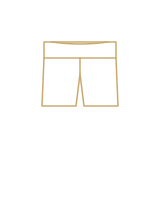
Project 1: Gym Shorts
The gym shorts are the single easiest beginner sewing projects in the catalog. If you have never sewn a garment before, start here.
Why Gym Shorts Are Perfect for Beginners
- Minimal pieces: A front panel, a back panel, and an elastic waistband. That is the entire pattern.
- Mostly straight seams: Side seams and inseam are straight lines. The crotch curve is the only curved seam, and it is gentle.
- No closures: The elastic waistband means no zippers, no buttons, and no buttonholes. Pull-on simplicity.
- Fast finish: Most beginners complete a pair in two to three hours.
Skills You Will Learn
Sewing gym shorts teaches you to pin and sew straight seams, create an elastic waistband casing, hem a leg opening, and finish raw edges. These are foundational skills for every bottom you will ever sew -- pants, trousers, skirts, and more.
Recommended Fabric
A lightweight woven cotton, cotton-linen blend, or chambray. These fabrics are easy to handle, do not stretch, and produce comfortable, breathable shorts.
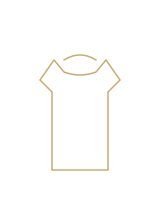
Project 2: Classic Tee
The classic tee is a close second among beginner sewing projects and arguably the most rewarding because you will wear it all the time.
Why the Tee Is Great for Beginners
- Few pieces: Front, back, and two sleeves.
- Core skills: Setting sleeves, finishing a neckline, and sewing side seams are all fundamental techniques.
- Forgiving fit: A tee has enough ease that small imperfections in your sewing do not show.
- Versatile result: A well-fitting tee is a wardrobe staple you will reach for constantly.
Skills You Will Learn
The tee introduces curved seams (neckline and armhole), setting sleeves into an armhole, and finishing a neckband. These skills are the foundation for all tops, blouses, shirts, and dresses.
Recommended Fabric
Cotton jersey (knit) for a stretchy, traditional tee feel. If you want an easier experience for your first time, use a woven cotton instead -- it does not stretch and is simpler to handle under the machine.
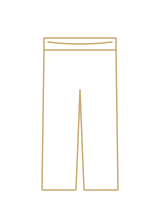
Project 3: Easy Pants
The easy pant is a relaxed, pull-on pant with an elastic waist. It is essentially gym shorts grown up into full-length pants. If you liked sewing the shorts, this is a natural next step among beginner sewing projects.
Why Easy Pants Work for Beginners
- Same construction as shorts, just longer. Side seams, inseam, elastic waist, and hem. If you have sewn shorts, you already know 90% of the process.
- No closures: Pull-on elastic waist, same as the shorts.
- More fabric to manage: This is slightly more challenging than shorts simply because the pieces are larger and there is more sewing to do, but the techniques are the same.
- Wearable result: Comfortable pull-on pants are endlessly useful.
Skills You Will Learn
Easy pants reinforce the skills from shorts and add experience managing longer fabric pieces. You will also practice more precise hemming since pant hems are more visible than shorts hems.
Recommended Fabric
Cotton twill, linen, or a cotton-rayon blend. These fabrics have enough structure for pants while being comfortable and easy to sew.
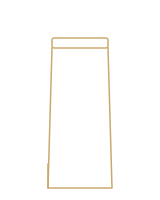
Project 4: Slip Skirt
The slip skirt is a beautiful and surprisingly simple project that rounds out the list of beginner sewing projects. It looks more sophisticated than it is to sew.
Why the Slip Skirt Works for Beginners
- Very few pieces: Typically a front panel, a back panel, and a waistband.
- Simple seams: Two side seams and a waistband attachment.
- Elegant result: A slip skirt looks polished and intentional. It is a garment that gets compliments.
- Optional zipper: You can choose an elastic waist to keep it simple, or add a zipper for a sleeker look once you feel ready.
Skills You Will Learn
A slip skirt teaches you to work with bias-cut or straight-grain panels, finish a waistband, and hem a skirt evenly. If you choose the zipper option, you will learn invisible zipper installation, which is a valuable skill for dresses and skirts.
Recommended Fabric
A satin-finish cotton sateen, crepe, or a lightweight linen. For your first attempt, a cotton sateen gives you the slip skirt look without the slippery challenge of real silk or polyester satin.
The Recommended Order
If you want to build your skills progressively, here is the order we recommend for these beginner sewing projects:
- Gym Shorts -- Simplest construction. Teaches seams, elastic waist, and hemming.
- Classic Tee -- Adds curved seams, sleeve setting, and neckline finishing.
- Easy Pants -- Reinforces shorts skills with longer pieces and more precise hemming.
- Slip Skirt -- Introduces waistband finishing and optional zipper installation.
Each project builds on the skills from the previous one, so by the time you finish all four, you have a solid foundation for any garment.
Why Custom Fit Matters Even for Simple Projects
You might think that beginner sewing projects like shorts and tees are casual enough that fit does not matter much. But here is the thing: wearing a handmade garment that fits you perfectly is what makes sewing addictive. If your first project fits badly because the standard pattern was not your size, you might lose motivation. If it fits great because the pattern was drafted to your measurements, you will want to make another one immediately.
Every pattern in the People's Patterns catalog is made-to-measure. Even the simplest beginner sewing projects benefit from custom fit. And your first download is free, so there is no risk in trying it.
Frequently Asked Questions
What is the single easiest sewing project for a beginner?
Gym shorts with an elastic waistband. They have the fewest pieces, mostly straight seams, and no closures to install. A pair of custom-fit gym shorts from beginner sewing projects like these can be finished in a couple of hours.
Do I need an expensive sewing machine for beginner projects?
No. A basic sewing machine with straight stitch and zigzag capabilities is all you need for beginner sewing projects. Entry-level machines that cost well under 200 dollars work perfectly well for all four projects listed here.
Should I sew a muslin for easy projects?
We recommend it, especially for your very first project. A muslin lets you practice the construction steps and verify fit before cutting your good fabric. For simple projects like shorts, the muslin itself only takes about an hour.
What order should I sew these beginner projects in?
Start with gym shorts (simplest), then move to a tee, then easy pants or a slip skirt. Each project in this sequence of beginner sewing projects introduces slightly more complexity while building on skills you already learned from the previous one.
Ready for your perfect fit? Start with a free pattern →
Patterns that use this
Related articles
How to Switch Between Inches and Centimeters in Your Pattern Tool →How to Save and Reuse Your Body Measurements Profile →Try these patterns
Generate a custom-fit pattern in minutes. First pattern free.